What we do
From design concepts, tooling and prototyping, to preparing 3D CAD and CAM designs, specifying materials and making products; we provide a complete design and manufacturing service.

State-of-the-art rotational moulding is our primary production method. With every project, we seek to maximise product performance, extend lifecycles and minimise costs.
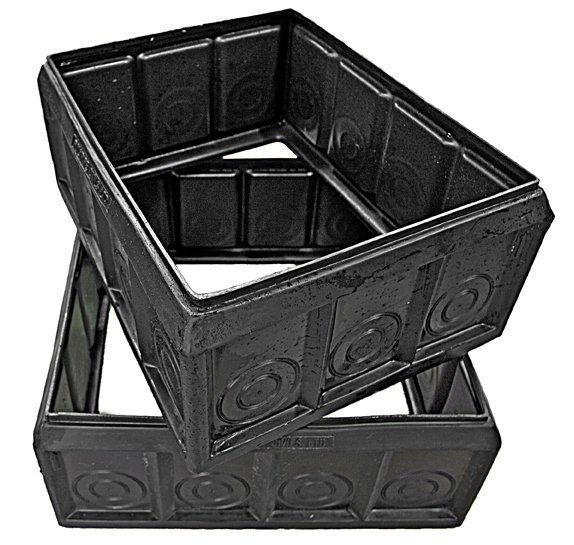
The rotational moulding process differs from other plastic moulding methods because the heating, moulding and cooling all take place when the raw material (polymer) is already inside the moulding tool, meaning no external pressure is required to form the shape.
It’s an ideal process for a variety of manufacturing scenarios including:
Tools are typically manufactured from aluminium or steel in two halves. Polymer powder is placed in the tool, which is locked and loaded into the oven. The tool is then rotated on two axes, distributing the polymer evenly around the inside of the tool.
The tool is heated at a controlled rate and the polymer sticks to the inside of the tool and because it is rotated simultaneously on two axes, an even coating builds up to form the product.
The tool is rotated for a period of time after the polymer has formed the shape to ensure that the product surfaces are properly formed and that no air bubbles have formed which could weaken the structure of the finished product. The tool is then cooled down either using air jets, water mist or water spray causing the polymer to cool down and retain its shape.
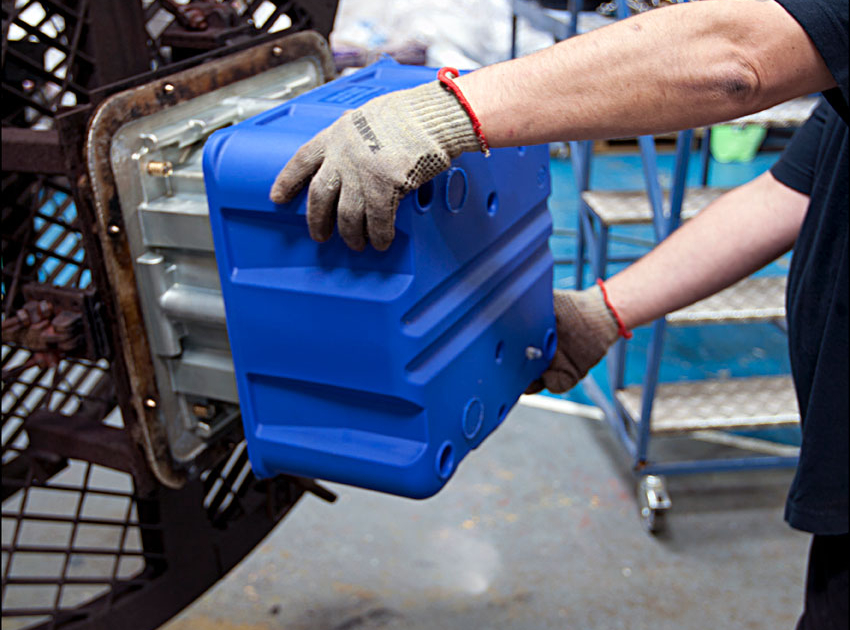
Finally the mould is opened and the finished product removed.
And repeat!
We’ve been designing innovative plastic products for nearly 40 years. Our team was responsible for designing the first plastic navigation buoy in the world and helped a young James Dyson with one of his earlier products, the Ballbarrow.
More recently, we’ve been developing a flexible ‘baffle’ that can be installed in rivers and culverts to aid cross-continent fish migration.
Thanks to our experience and forward-thinking approach, whatever the product or wherever you are in the design process, we will be able help you take it into production.
Corilla Plastics has the expertise, resource and capacity to take your product into production, whether you have existing tooling or not.
From designing your product, to manufacturing, assembly and even delivery to your customers, we are a one-stop shop for any trade moulding requirement.
Our dedicated quality team reviews every single product that enters and leaves our facilities to ensure that they’re manufactured to the highest of standards.
Take a look at this video from Corilla Marine to understand our manufacturing process.
When a product comes out of the mould, the process doesn’t always end there – that’s why we offer an assembly service. This can include routing the moulding to accept secondary parts, fitting other parts or inserts into the moulding and welding on external connections. We can even add electrical items such as fuel sender units if necessary.
Once this finishing process is completed, we can arrange delivery to you or third party clients as required, both nationally and internationally.
Before any design goes into full manufacture, comprehensive testing and quality control checks should be completed and at Corilla Plastics we can help you do exactly that. In fact, rigorous testing is an every-day part of our approach and it’s something we pride ourselves on.
Full project management support is available for all product testing requirements; we can provide complete certification and verification ID and any necessary product compliance documentation and reporting such as FMEA, ISIR, PPAP & PSW.
Amongst the many tests we undertake are:
We also test for warpage, PIAT, tensile modulus, stress and strain at yield and at break, ARM impact, ESCR (FNCT), heat deflection temperature and shore durometer.
In addition to manufacturing products on behalf of clients and our own product lines, at Corilla Plastics we offer a comprehensive range of rotational moulding consultancy services to help you with your own projects.
Our consultancy services break down into three areas; design, technical and manufacturing, but in reality it is our expertise across all three disciplines which allows us to add value to projects.
With regard to rotational moulding design, perhaps the most fundamental question we ask is whether rotomoulding is appropriate. For a lot of products, rotational moulding offers considerable benefits over other manufacturing processes. It is particularly suited to large, hollow shapes and lower volume production runs. The set up costs are comparatively low and products are moulded without pressure being applied making it an excellent choice for many applications.
But it is not the right process for every project and our design consultancy services will help determine if it is right for yours.
Involving Corilla Plastics at the design stage can also help to cut costs by engineering ‘out’ unnecessary components or functionality. For example – we assisted with the re-design of a fuel tank which originally had a filler neck and moulded tube as part of the finished product. Our input at the design stage meant we were able to suggest removing the filler neck and tube and replace them with off the shelf components. This greatly reduced the cost of the mould and the production time, offering significant savings.
To some extent, design decisions will be heavily influenced by our technical and manufacturing expertise and vice-versa. However as a standalone function, our technical consultants will look at material choice, thickness, stiffness and flexibility of the finished article and advise on how best to achieve the desired output.
For example, we manufactured a material handling ‘caddy’ that was used to move vehicle engines around a factory to various assembly stations. The load bearing points on the block meant that we needed to strengthen several specific corners for the caddy to handle the weight of the engine block. By specifying key criteria for the mould, the wall thickness of the finished product could be varied to ensure the finished article was fit for purpose.
Our technical consultancy is also able to advise on how products can be manufactured to perform better. Clients will often specify that a product must have a usable life of x years, from which they can derive a price to sell the end product. Thanks to the relative ease with which we can accommodate the finished wall thickness of a product, we frequently find that a product can be engineered to last considerably longer than anticipated, giving a higher resale value for a relatively low increase in production costs.
The culmination of being involved in the design and technical specification stages for a product should mean that come the production phase, all goes well and for our customers who involve us at the earlier stages this is the case.
However, we are often asked for advice on how to improve a product that is already being manufactured elsewhere. The nature of rotationally moulded plastic products means that a large number of variables are in play at any given time and experience is the best way to overcome any issues that arise. For example, is the product being over or undercooked, cooled too quickly, or does the mould have a design flaw which is stopping heat from reaching all sections of the mould at the correct temperature.
We are always happy to look at existing mouldings with a view to improving your production techniques.
Many of our clients involve us in the design stage of their projects to visualise and produce concept prototypes.
It’s a crucial step of the process that ensures the design is tested as rigorously and comprehensively as possible. In fact, engaging a manufacturer like Corilla Plastics at an early stage may save you time and money, not to mention making a distinct difference to the overall performance of the end product.
There are many ways to produce prototypes from basic wooden or plastic fabricated models to full CNC machined parts. If needed, to avoid unnecessary costs and delays we can also test and prove individual elements of the design concepts before committing to full prototypes.
Because our designers work with the latest CAD technology, we can provide you with highly detailed three-dimensional views of your product well before it’s manufactured.
Our wide knowledge of the market puts us in the best position to specify the right tool-maker and materials for your specific need.
We’ll help you determine whether aluminium casting, CNC machining or sheet metal fabrication should be considered in the tool’s development, and whether there’s there a need for timber modelling at the prototyping stage. Whatever the answer, you can rest assured that our tooling experts will work with you to determine the best overall approach for the job.